

“We’ve updated our Terms and Conditions. By continuing to use our products and services, you agree to the updated terms.”
Let’s be honest, this is the kind of email that goes straight into the trash can. But before you swipe it away this time, I’d like to take a moment to talk about it.
Writing like this isn’t new by any means. Immediately, due to how the first line is written, we’re being told that even if this email ends up in our spam folder and never gets read, we’ve still agreed to it. The opening line serves as a mask for anything else they’d like to impose on us, which we’d often reject if asked upfront, which is why it’s being disguised. We’ll investigate precisely what’s being hidden from us after a bit of catch-up.
Cloud-connected services have completely transformed the way we use technology in our everyday lives. Take a moment to picture the way email used to work on your home computer 25 years ago. Hold on to that picture, and put it next to the way you stay updated with your inbox now. Quite the difference, isn’t it? Most mobile devices, like cell phones, remain constantly connected to the user’s configured email server through something called a push server. It’s an efficient way of ensuring you can receive instant notifications for new emails without compromising device performance and battery life. Even if you don’t have push notifications enabled for email, this “push” technology is still active in the background unless the user explicitly disables it. The result of all this, is email communication being nearly as fast and convenient as SMS messaging.
Similarly to the convenience of on-the-go email, we’ve also become accustomed to it being free. Today, Google remains the most widely known company that offers free email. They even provide you with a whopping 15 gigabytes of free storage to show for it, whereas most other companies limit you to just 2 or 5 gigabytes. There’s a problem, though. Server storage and bandwidth cost money. If you’re not paying for your email, who is? For quite a while, the answer was advertisers. As part of Google’s massive (and highly effective) online advertising dominance, they would use the contents of your emails to personalize advertising across the web, not just within Google’s services.
However, people began to notice the increasing creepiness in relevancy of online ads, to the point where they could almost read their mind. When they found out that their email contents being used in this way were part of the reason, they weren’t happy about it. In fact, there ended up being enough public backlash that Google abruptly stopped the program before they lost their users’ trust. Something must have changed, then, for similar actions to be considered acceptable today.
In order for companies like Yahoo and Microsoft to compete, they had to find a way to make everything “free”. Just by hopping between these services, it’s apparent that Google’s feeling a lot more secure about themselves than most others out there. Part of this has to do with the way they dominate the web with their advertising business. In 2024, they made $264 billion just from collecting your information and using it for targeted advertising. A company that collects that much from their users without them paying a dime can afford to offer 15 gigabytes of free email space without too much of a worry. They could probably go even higher than that. The rest of the pack, like Yahoo and Microsoft, have to resort to other tactics, some less ethical than the rest.
Let me ask something. What do you value in an email service? For me, I expect it to be reliable and easy to use, have features like creating filters for my messages, and being able to block spam emails. I also expect it to work well with a variety of third-party email clients, like Mozilla Thunderbird or the stock Mail app on my phone. And of course, I expect to be able to communicate privately, and hope the company has good security, preventing my sensitive emails from being leaked.
That last part about having a private and secure email inbox is something many people often forget they value, at least to an extent. It’s easy to see why. It really never occurred to me that someone would be able to read through everything I have saved in my email. When I think of that happening, images of my laptop or phone being snatched, someone peering over my shoulder, or my data getting hacked come to mind. What doesn’t come to mind, is the service that I’m trusting with my email to be doing that exact thing. Why would they be doing that, anyway? I mean, if people discovered that their private emails were being shared with random entities, they certainly wouldn’t be happy. They might even become furious, take action, or quit using that email provider. Or at least they would have, 15 years ago. Unfortunately, these practices have been normalized in our digital world. But before we get to the why of that, let’s see what just slipped through the cracks.
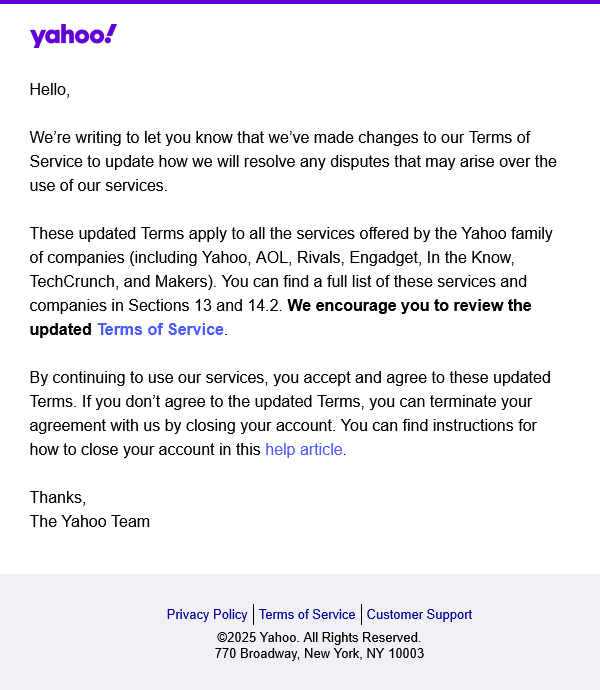
Here’s the email I received from Yahoo on March 15th. The only thing that looks like a red flag is the update to how disputes are resolved, but that’s not related to this article. The email’s devoid of anything that has the potential to raise customer concern, of course. Don’t worry, I did the digging for you. In section 6, we see two things of interest.
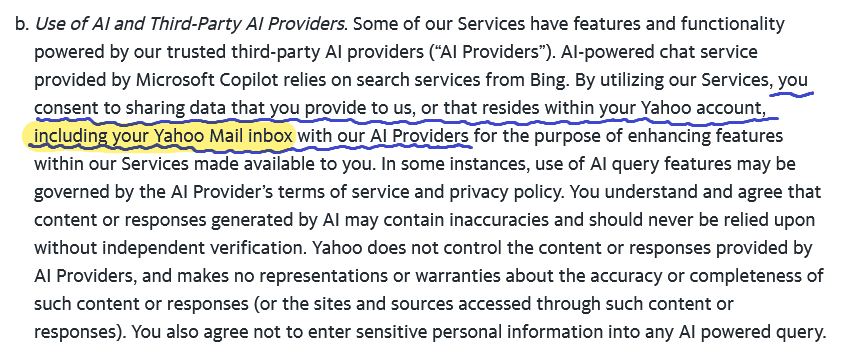
This first section simply says that our data will be shared with any third-party AI providers that we use with the service. Makes sense, given the fact that when I logged into my inbox recently I was greeted by this message.
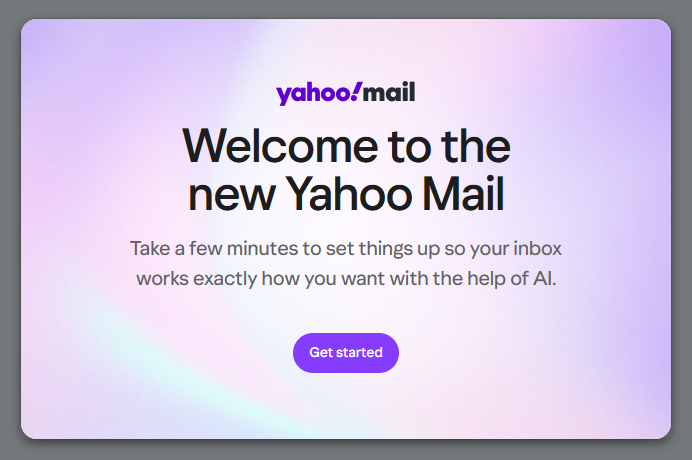
It’s the typical feature push, “Get started”, with no option to cancel or not enroll.
This next part, though, is even more concerning.
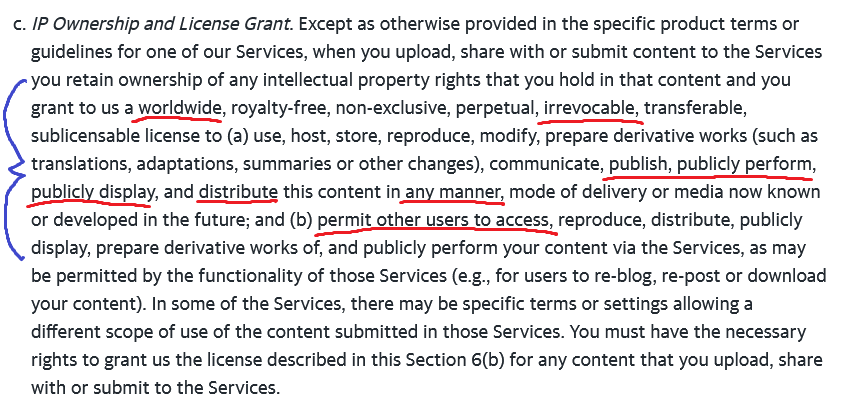
The “content” they’re referring to? Those are my emails. Not just my emails, but any data I’ve shared, or Yahoo’s collected about me over time. This includes my physical location information, news articles I’ve read, my entire address book… everything. What exactly can they do under this license? It appears to mean anything they want. Just look at how many danger phrases there are. “Irrevocable license”, “distribute in any manner”, “prepare derivative works from”, “permit other users to access”… What kind of person would be okay with this?
I’m hoping I don’t need to elaborate on why this is a warranted cause for concern, but if I do, it would be the amount of control we’re giving up, combined with the severe lack of concrete information we’re dealing with. They’ve essentially just shielded themselves against any legal trouble they may encounter down the road. They’ve given themselves something to point a finger at anytime they’re accused of unethical behavior. The only thing that makes sense to me in the above snippet is where they state that I “retain ownership of any intellectual property rights”. Probably because they’re intellectual property rights. The rest of it descends into madness. When’s the last time you cleared your email inbox? Your trash? Archive? Do you remember every single email you’ve sent and received? Every attachment? Every calendar event? Even the physical location and time each action was taken? You might not, but Yahoo does. What’s going to happen with all that data now?
The truth is, we don’t really know. We can speculate though, by observing current industry patterns. Artificial intelligence and machine-learning technology has been taking off in spades in recent years, and it’s also one of the reasons for this update from Yahoo. It’s interesting to see both organizations and regular people use the tech, and make comments like, “Look at all the things AI is able to create!”. I feel that comment is particularly relevant in this scenario, and where your Yahoo data could be going. You see, there’s a reason why AI is one with machine-learning. It’s because AI on its own can’t create new things. It takes things that real people have already created, learns from them, and then generates content using that data as a base. The original authors are almost never paid, credited, or even told that their work is being used in this way. In order for any of these conglomerates like Apple, Google, Microsoft, or Yahoo to develop an “AI-powered” anything that’s actually useful, they need swarms of data, and there’s no better place to get it than from their millions of customers. It doesn’t matter if you’re okay with it or not, because all they need to do is a send a single email and they have everyone’s consent, even if you never open it.
Google’s already been using their customer’s data for AI-training, but their practices have been largely ignored. Their predictive text features in Google Docs and Gmail are, like their personalized ads, eerily good at predicting the exact thing you were trying to say. This is done by analyzing and learning from everything users submit to the platform, just like Yahoo will begin doing. Once your data is used to train these models, there’s no getting it back. How are you able to control what your data is used for? Even Grammarly, a tool that millions of users rely on to spell-check their writing, is now touting itself as the “AI Writing and Grammar Checker App”. Without human data though, these tools are as dumb as a brick. That’s why I’ve stopped using the ones I can, to cease feeding the beast. Inevitably, putting my content on the internet means it eventually will be scanned and indexed by some array of machine-learning tools. But why expedite that process by installing software that just gives it away? It’s your creative work. You spent precious hours of your own life crafting something unique, that corporations are going to take from you and make money from for free. Own yourself, and your data. There’s a reason harvesting it is a billion-dollar industry.
So, what does all this mean for your content with Yahoo? It’s now more subject to the same problems that arise from other data collection. The age-old saying, “knowledge is power” remains true here the same way it always did. The more of your private life you allow to be passively collected, the more vulnerable you make yourself against problems that arise in the future. It’s easy to walk away with the “…but I don’t have anything to hide” mindset. If people truely didn’t care about their privacy, then they wouldn’t put a sticker over the camera on their laptop, or install privacy screen protectors on their phones. To some degree, people do. It’s just that this technological barrier makes it virtually impossible for them to make any meaningful sense of what’s going on. Remember when abortion laws got shifted around? A significant portion of the population that had “nothing to hide”, suddenly realized that that was a dangerous precedent to set. You have no clue or control over what will happen in the future, and you can’t wait for these moments to start taking action. Why take the unnecessary risk?
Where do we even go from here? I’ll keep doing my part, writing about current events, and explaining the history of past ones, in an effort to make this rabbit whole even slightly more intriguing. If you’re at all concerned, the best thing to do is to just keep learning. The more you understand the current position of the ever-evolving tech industry and how it affects you, the better you’ll be able to defend yourself and reason when given the chance. In the future, I’ll have more resources explaining this from an overall perspective, and give tips on how to better control and protect your identity. Some tides have already fully rolled over. Many consumer electronics are designed to be completely un-serviceable, draining your wallet and contributing to e-waste. Physical media purchases are becoming digital only, and companies are able to delete your purchased media without giving your money back. Both of these are cultural shifts that likely would not have happened if people understood what was going on at the time and pushed back. Someday, it’ll likely happen to something you’re passionate about. Technology is encroaching on every industry imaginable. The more we let slip through the cracks, the bleaker the future of it all becomes.
Support independent, ad-free publishing